Skiaform / Guides
Architecture cover letter: examples and a free template
Write a short architecture cover letter: two fictional examples, a paragraph-by-paragraph structure, and a free editable template in Word and PDF.
Your architecture cover letter connects the work in your portfolio to the position you want. Give the reader a reason for choosing the office, one project that supports your application and the dates you can work. Use the fictional examples below to see how those details fit into a short letter.
Architecture cover letter examples
These two fictional letters cover a student internship and a recent graduate's first job. All people, organizations and projects in the samples are fictional. Replace every detail with your own; use the paragraphs to understand what each part contributes.
Internship letter
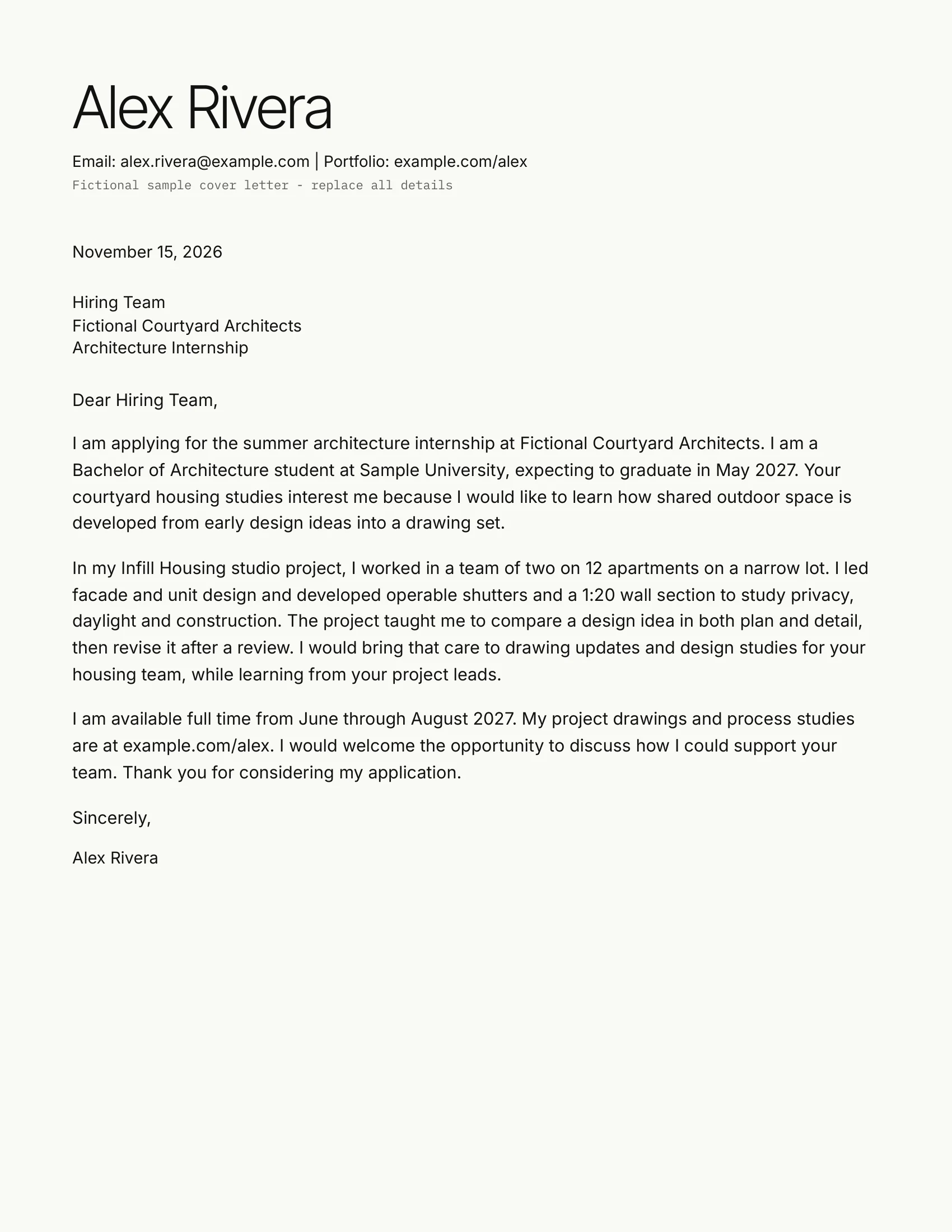
Alex Rivera's fictional architecture internship cover letter opens with the summer role and an expected May 2027 graduation date. The first paragraph connects the office's courtyard housing studies to an interest in developing shared outdoor space into drawings. In the second, you can see the evidence: Infill Housing, a team of two, 12 apartments, and Alex's facade and unit design contribution. The operable shutters and 1:20 wall section explain what the project studied: privacy, daylight and construction. The paragraph ends by tying that work to the drawing updates and design studies an intern could help with. The last paragraph gives June through August 2027 availability, points to the project drawings and process studies, and asks for a conversation.
First-job letter
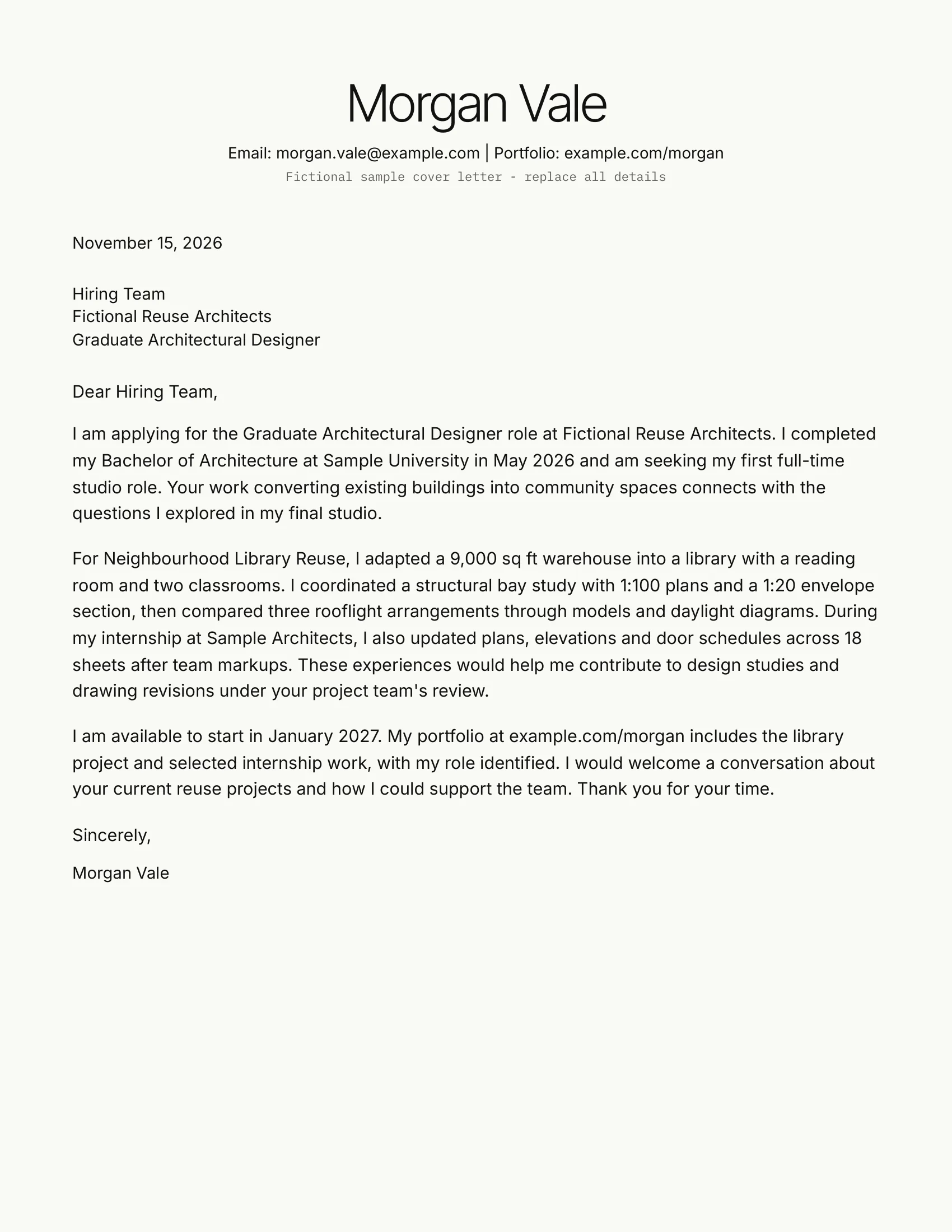
Morgan Vale's fictional first-job letter uses its opening paragraph to name the Graduate Architectural Designer role, establish a May 2026 graduation date and connect the office's reuse work to final studio. The second paragraph develops that connection through Neighbourhood Library Reuse: a 9,000 sq ft warehouse adapted into a library. You can see how the structural bay study, 1:100 plans, 1:20 envelope section and comparison of three rooflight arrangements support the application. The same paragraph adds internship work, updating plans, elevations and door schedules across 18 sheets after team markups, and describes it as work done under the project team's review. The closing paragraph gives a January 2027 start date and points to a portfolio where Morgan's role on each project is identified.
Structure, paragraph by paragraph
Skiaform's advice is to aim for about 250 to 350 words and stay under one page. Treat that as an editing target. Combine the opening and office-specific reason when that reads naturally, as the samples do, and leave enough space for the project evidence.
Header and greeting
Put your name, email and portfolio address at the top, followed by the date and recipient details. Use the same contact information as your resume. Address a person only when you have found the right name for that application; check its spelling and never guess a gender. Otherwise, address the hiring team or the studio by name.
Opening
Name the role and say where you saw it, using the posting's title. Add one sentence on who you are: your degree and expected graduation date, or your recent graduation and relevant experience. If you are making a speculative application, say what kind of position you are seeking. Keep the background short enough to reach your reason for applying quickly.
Why this office
Choose one project, approach or kind of work you have actually looked at. Explain what interests you about it and how that connects to work you have done or want to learn. Refer to something you can discuss if asked. Calling an office award-winning gives little sense of your reason for applying; a specific observation about its housing or reuse work gives you more to say.
Evidence
Choose one portfolio project related to that reason. Identify its academic or office context, explain your part and name the drawings you produced. A plan study, wall section or set of interior elevations can make the contribution clear. For team work, distinguish your responsibility from the group's result.
Connect the example to a task you could support in the role. Keep the claim within your experience: revising drawings after a review does not establish responsibility for an entire project. Let the portfolio carry the fuller account.
Practical close
Give your availability dates and your location or relocation plans where relevant. Include the portfolio link and a brief thank-you. For a summer placement, state the period you can work; for a graduate role, give your possible start date. Check that these details agree with the application form and resume.
Internship letters versus first-job letters
In a cover letter for architecture internship applications, make your availability easy to find and explain what you want to learn. Use studio work as evidence when you have little office experience. Identify the drawings you made and a decision they helped you test.
For a first job, give more space to office tasks from internships. Name the phases you worked in and the software you used on real drawing sets, where you can substantiate both. Keep final studio work when it explains your interest in the office, as Morgan's letter does.
What to leave out
Avoid retelling your resume line by line. Choose the experience that explains this application and leave the full chronology in the resume. Leave salary expectations out unless the posting asks for them, and avoid turning the letter into a narrative about unexplained gaps.
Remove praise you could send to any firm. Check verbs on team projects so they describe your actual part, and omit attachments the posting did not request. When adapting an architect cover letter example, replace any title or responsibility that does not match your experience.
Send it with the portfolio
Point to one or two projects the reader can find easily. Match their titles across the letter, resume and portfolio, and make sure the pages support your description of your role. Keep your portfolio PDF under 10 MB, following the same advice as the architecture portfolio layout guide.
Use the architecture resume guide to check the accompanying experience entries. If the posting asks for a single PDF, follow that instruction and check the combined file before sending.
Email or upload
For an email application, the email body can serve as your short letter, with the resume and portfolio attached, unless the instructions say otherwise. Use a subject line containing the role and your name. Check the attachments after adding them to the message.
On an upload form, follow the field labels and requested file formats. If it gives you a text field for the letter, check paragraph breaks after pasting. Read the completed fields once before submitting.
AI and your letter
You may use an assistant to tighten wording, while keeping the reasons, project facts and claims your own and true. Check every fact it touches against your work and the application, including names, responsibilities and dates.
Download the free cover letter template
The internship example above is set in the free layout. The free ZIP contains a cover letter in that layout, with editing prompts and its own sample text, and a matching resume in type set A, in US Letter and A4 sizes. Each comes as an editable Word file and a text-based PDF, with a README and free font links; fonts are not bundled.
Use the free template signup to get the download. Read the README before editing, replace the sample text and inspect your exported file for page breaks and working links.
The Skiaform Resume Set, coming soon, adds three more layouts with matching letters.
Check before sending
- Check the firm name and role everywhere they appear.
- Check the recipient's name and spelling if you address a person.
- Give one specific reason for applying to this office.
- Describe one relevant project and your own part in it.
- Confirm your availability dates and any location details.
- Open the portfolio link from the finished letter.
- Name the PDF Firstname-Lastname-Cover-Letter.pdf, using your name.
- Read the letter aloud once to catch awkward wording and omissions.
FAQ
Do architecture firms read cover letters?
Some do and some don't. Write yours in case it is read, and keep it short enough to read in under a minute. Use the space to connect your work to the role.
How long should an architecture cover letter be?
Skiaform recommends about 250 to 350 words, under one page. Treat that as an editing target and follow any length limit in the posting. Cut repeated background before shrinking the type.
Who should I address it to?
Use a person's name when you have confirmed they are the right recipient. Otherwise, address the hiring team or the studio. Avoid guessing a name, title or gender from incomplete information.
Do I need a letter if the application says optional?
Consider including one if you can explain a specific reason for choosing the office and support it with your work. An optional letter gives you room for that connection. Keep it brief and follow the application's instructions.
Can I reuse one letter?
Reuse the structure and accurate project details where they fit. Rewrite the why-this-office paragraph for each application, and reconsider the project you use as evidence. Check the recipient, role and dates throughout the file.
Should my letter mention software?
Mention software when it helps explain work relevant to the position. Tie it to a task you completed, such as updating plans after markups, and describe your responsibility accurately. Leave the broader software list in your resume.
Get the free cover letter template
Sign up with your email to reveal the ZIP: a cover letter and a matching resume, Letter and A4, in DOCX and PDF.