Skiaform / Guides
Aircrete: recipe, ratios and a batch calculator
How to make aircrete: the recipe, a batch calculator for cement, water and foam, and sourced data on density, strength, insulation and cost.
Aircrete is a cement-and-water slurry mixed with preformed foam and cured without an autoclave. Factory-made autoclaved aerated concrete (AAC) gets its bubbles from a chemical reaction and cures in pressurized steam. The foam makes aircrete light and insulating, but low-density mixes have limited strength and need engineering for any structural use. Domegaia’s Aircrete 101 · ASTM specification for AAC
| What it is | Portland cement and water slurry with pre-formed foam mixed in, cured at air temperatureACI 523.1R §1.1, §2.3 |
|---|---|
| Not the same as | Factory AAC, which is made with aluminium powder and steam-cured in an autoclaveASTM C1693 scope |
| Common DIY density | About 22 lb/ft³ (Domegaia's recipe); concrete is about 150 lb/ft³Domegaia (DIY) |
| Compressive strength | 70 to 125 psi at 20 to 25 lb/ft³ oven-dry; structural concrete starts at 2,500 psiACI 523.1R Table 3.1; ICC on ACI 318 |
| Insulation | About R-1.3 per inch at 20 lb/ft³, oven-dry (less when damp)ACI 523.1R Table 3.3 (k = 0.75) |
| Basic batch | One 94 lb bag of cement, 6 US gal of water, then foam to the target densityDomegaia (DIY) |
| Main limits | Weak in tension, soaks up water, needs a sealed finish outdoors; not structural without an engineerACI 523.1R §3.4, §3.11; CEMATRIX data sheet |
The aircrete recipe
A basic aircrete recipe has three components: Portland cement, water for the slurry, and preformed foam. A common DIY starting batch in Domegaia’s guide uses one 94 lb bag of cement and 6 US gal of slurry water. Domegaia’s Mearlcrete-S directions give 6.8 US gal for the same weight of Type I/II cement. As worked examples, those amounts give water-to-cement ratios by weight of about 0.53 and 0.60, respectively. Domegaia’s Aircrete 101 · Mearlcrete-S directions
The calculator sizes a batch by finished volume, block count, or bags of cement. It starts at 22 lb/ft³ wet density, a 0.53 water-to-cement ratio, 50 g/L foam density, and zero foam loss. Set your bag weight and use the concentrate dilution on your product label. The default is 1:50 concentrate to water, a dilution listed in Aerix Industries’ Aquaerix-HD flyer. The outputs give quantities of cement, slurry water, prepared foam, and foam concentrate.
Aircrete batch calculator
Cement, water, foam and foam concentrate for a target batch size and wet density. Quantities only. It does not predict strength.
Mix assumptions
The calculator splits the batch into a cement-water slurry and pre-formed foam so the mix reaches the target wet density, assuming the volumes simply add. Foam loss adds extra foam for bubbles that collapse in the mixer. Defaults: water:cement 0.53 (a common DIY batch of one 94 lb bag with 6 US gallons of water), foam 50 g/L (within the 40 to 65 g/L typical range in ACI 523.1R), and 1:50 dilution (one foam concentrate maker's ratio). Use the dilution printed on your own concentrate. Real batches vary with the foam, the mixer and the cement: weigh a test cup of your mix and adjust the foam until the wet density matches.
How to make aircrete
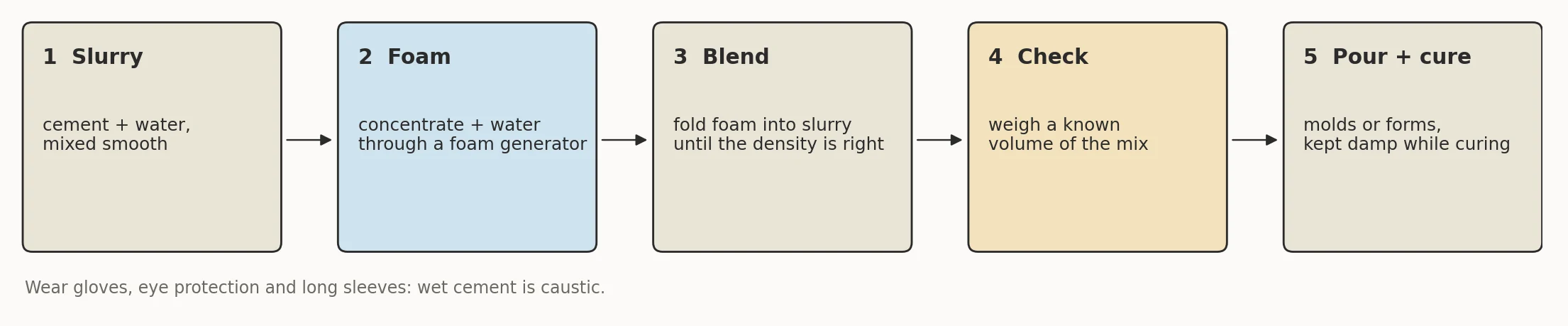
Mix the slurry
Domegaia’s DIY method starts with water in the mixing container, then adds the cement. Mix the slurry before introducing any foam. The American Concrete Institute’s ACI 523.1R-06, Guide for Cast-in-Place Low-Density Cellular Concrete, also places preformed foam after the slurry ingredients in the mixing sequence and recommends checking proportions with trial batches. Domegaia’s Aircrete 101
Generate and weigh the foam
A foam generator takes diluted concentrate and produces the foam separately from the slurry. Domegaia’s DIY Dragon XL setup uses a pump and an air compressor. ACI 523.1R-06 gives a typical preformed foam density of 2.5 to 4.0 lb/ft³ (40 to 65 kg/m³). Domegaia’s Mearlcrete-S product directions specify 38 g/L, while its guide gives 90 to 100 g/L as a DIY target for dish-detergent foam. Use the target for your product and weigh a known volume of the generated foam before batching. Dragon XL · Mearlcrete-S directions · Domegaia’s Aircrete 101
Blend, check wet density, and pour
Blend the measured foam into the slurry. ACI 523.1R-06 notes that excessive mixing can change density and calls for checking cast density at placement. For a DIY batch, weigh an empty container of known volume, then fill it with fresh aircrete and weigh it again. Subtract the empty weight and divide by the container volume. With weight in pounds and volume in cubic feet, the result is wet density in lb/ft³.
Compare that reading with your target before pouring into the forms. If it differs, use the measured density to assess the trial batch and recheck after any adjustment. Record the foam density as well as the wet mix density so you can reproduce the batch.
Aircrete density, strength, and insulation
Choosing a wet density
Domegaia reports 22 lb/ft³ for its DIY recipe without specifying whether the measurement is wet or dry. It also describes mixing in a 45 gal container and adding foam to a few inches below the top. As a worked example, the guide’s 94 lb bag and 6 gal of slurry water would yield about 54 gal at 22 lb/ft³ wet with 40 g/L foam. Size the trial batch to your container and verify the result by weighing it. Domegaia’s Aircrete 101
Our mix model adds the volumes of cement solids, slurry water, and prepared foam. It divides their combined weight by that total volume to estimate wet density. The model uses a cement specific gravity of 3.15, as listed in Quikrete’s Portland cement safety data sheet. Quikrete Portland Cement SDS
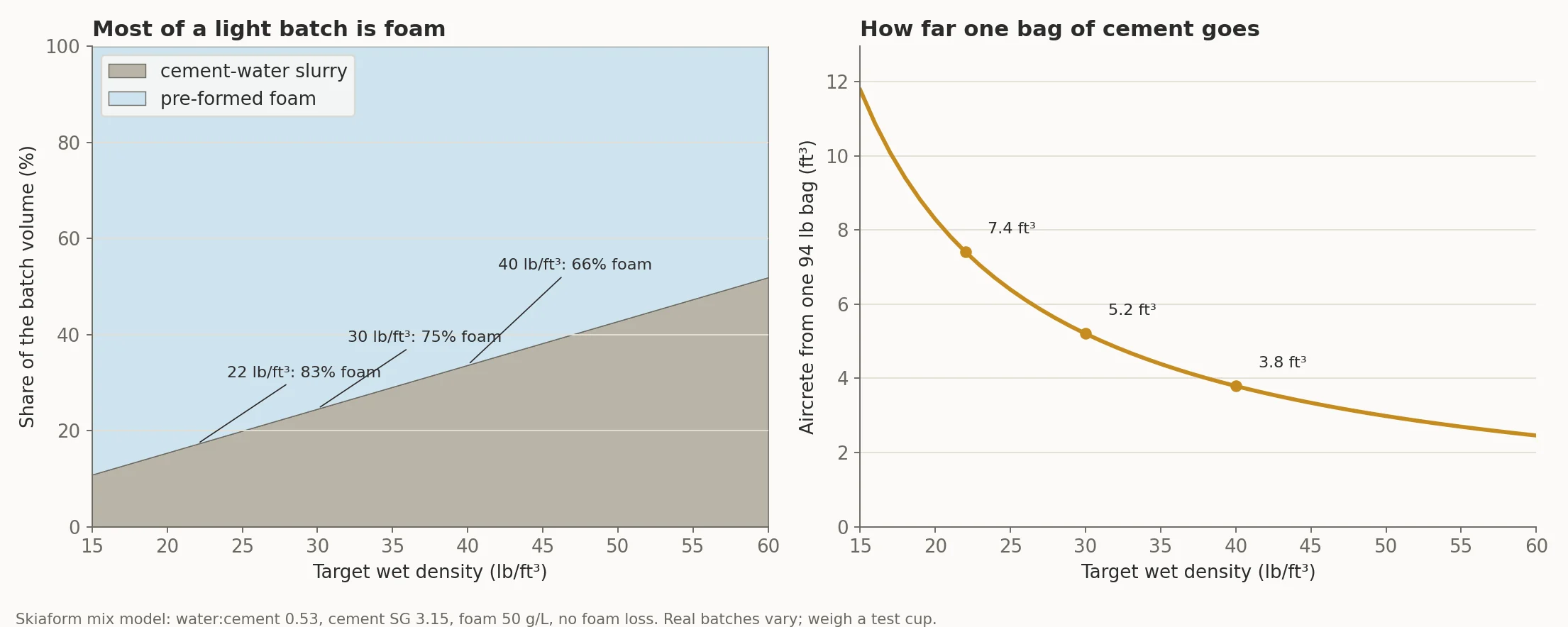
At 22, 30, and 40 lb/ft³ wet, our mix model puts foam at about 83%, 75%, and 66% of the batch volume, respectively. The corresponding yields are about 7.4, 5.2, and 3.8 ft³ per 94 lb bag, using a 0.53 water-to-cement ratio, 50 g/L foam, and no foam loss. Use those values to plan quantities, then measure the wet density of the actual mix.
Strength and insulation by density
ACI 523.1R-06 defines low-density cellular concrete by its hardened oven-dry density of 50 lb/ft³ (800 kg/m³) or less. Its roof-deck strength guidance uses oven-dry density, while its geotechnical fill examples use cast density. Check which measurement a source reports before comparing it with a fresh batch.
| Oven-dry density | 28-day compressive strength | Thermal conductivity k | About R per inch |
|---|---|---|---|
| 20 to 25 lb/ft³ (320 to 400 kg/m³) | 70 to 125 psi | 0.75 at 20 lb/ft³ | 1.3 |
| 25 to 30 lb/ft³ (400 to 480 kg/m³) | 125 to 225 psi | 0.91 at 30 lb/ft³ | 1.1 |
| 30 to 35 lb/ft³ (480 to 560 kg/m³) | 225 to 350 psi | ||
| 35 to 40 lb/ft³ (560 to 640 kg/m³) | 350 to 450 psi | 1.11 at 40 lb/ft³ | 0.9 |
| 40 to 50 lb/ft³ (640 to 800 kg/m³) | 450 to 750 psi | 1.36 at 50 lb/ft³ | 0.7 |
| For comparison | Structural concrete: at least 2,500 psi. Factory AAC: 290 to 870 psi. | Tensile strength of cellular concrete is about 10% of its compressive strength. | |
Strength: ACI 523.1R Table 3.1 (roof-deck mixes, guideline values). k in BTU·in/(h·ft²·°F): ACI 523.1R Table 3.3; R per inch = 1/k, our arithmetic. Structural minimum: ICC Concrete Manual on ACI 318. AAC: Matthys and Barnett, ASCE 2004. Tension: CEMATRIX data sheet.
For the Type I cement roof-deck mixes in ACI 523.1R-06, the 20 to 25 lb/ft³ (320 to 400 kg/m³) oven-dry band corresponds to 70 to 125 psi (0.48 to 0.86 MPa) at 28 days. The 40 to 50 lb/ft³ (640 to 800 kg/m³) band corresponds to 450 to 750 psi (3.10 to 5.17 MPa). The guide assigns low-density cellular concrete on roof decks no structural contribution. For comparison, the ICC Concrete Manual reports an ACI 318 minimum specified compressive strength of 2,500 psi for structural concrete. ICC Concrete Manual
For insulation, a worked conversion of the thermal conductivity values in ACI 523.1R-06 gives about R-1.33 per inch at 20 lb/ft³ (320 kg/m³) and R-0.74 per inch at 50 lb/ft³ (800 kg/m³). Both values are for oven-dry material. Moisture increases thermal conductivity. Domegaia claims R-1.8 to R-2.2 per inch for DIY aircrete, higher than the values calculated from the ACI table. Domegaia’s Aircrete 101
Curing, shrinkage, and waterproofing
Domegaia’s DIY method lets the cast mix harden overnight, covers it with plastic to retain moisture, and calls for sprinkling with water in dry climates. Overnight describes initial hardening in that method. The ACI roof-deck strength figures above are measured at 28 days. ACI 523.1R-06 also describes water curing or using a curing compound for roof-deck mixes when rapid drying is expected. Domegaia’s Aircrete 101
ACI 523.1R-06 reports typical drying shrinkage of 0.30% to 0.60% after six months at 50% relative humidity and 73°F. Shrinkage increases as density decreases. The guide describes using fibers to help control plastic shrinkage cracking.
Aircrete can absorb water. A published review reports a test in which a microsilica foam concrete at 500 kg/m³ absorbed water equal to 53.6% of its volume. Domegaia claims aircrete is unharmed by moisture, but its dome method calls for fiberglass-reinforced stucco and a waterproof finish. For material near a surface exposed to freezing and thawing while wet, ACI 523.1R-06 gives a minimum density of 36 lb/ft³ (575 kg/m³). Foam concrete review · Domegaia’s Aircrete 101 · Domegaia building method
Aircrete blocks, insulation, and domes
ACI 523.1R-06 describes low-density cellular concrete in roof insulation, slope fill, pipe and culvert fill, and other void fills. Published foam concrete research also describes non-load-bearing blocks and partitions. DIY builders following Domegaia’s method cast blocks in forms and use them to assemble domes. Keep DIY batches out of load-bearing walls, footings, and foundations unless an engineer designs the assembly for that use. Foam concrete review · Domegaia’s DIY aircrete guide
Planning an aircrete dome
In Domegaia’s DIY building method, the blocks are one part of a shell that also includes mesh-reinforced stucco and an exterior finish. If you are exploring dome geometry or planning a greenhouse, see the geodesic dome calculator and the dome greenhouse guide. For a habitable dome, take the proposed assembly to an engineer and check the locally adopted building code with your building official. The 2018 IRC’s R104.11, as reprinted in an ICC code-change agenda, describes how a building official may approve an alternative material based on equivalence in areas including strength, durability, and safety. Domegaia building method · ICC code-change agenda
Safety when mixing and cutting
Wet Portland cement can cause severe skin burns and eye damage. Quikrete’s safety data sheet warns that burns can develop with little warning. Wear waterproof, alkali-resistant gloves and eye protection, keep slurry out of your gloves, and control dust when handling dry cement. Check the safety data sheet for your foam concentrate as well. The sheet for Aerix Aerlite-iX, for example, calls for gloves and eye or face protection. Quikrete Portland Cement SDS · Aerlite-iX SDS
For cutting or drilling, OSHA’s construction silica rule gives a benchmark for dust control. Its work practices include a continuous water feed to the blade for handheld power saws and a shroud with dust collection for handheld and stand-mounted drills. The rule also specifies respiratory protection for some tasks and conditions. OSHA construction silica standard
What does aircrete cost?
A 94 lb bag of Quikrete Portland cement was $17.21, seen on November 22, 2026 at The Home Depot. That was a local store price, and local prices vary. The Home Depot cement listings
A 5 gal container of Mearlcrete-S was $595, seen on November 22, 2026 at Domegaia. The Dragon XL foam generator was $499, and the foam-injection mixer was $246, also seen on November 22, 2026 at Domegaia. Mearlcrete-S · Dragon XL
As a worked example, divide the cement price by the model yield of 7.4 ft³ at the default wet density. That gives about $2.33 per ft³ for cement. Using Domegaia’s claimed yield of 215 ft³ of aircrete per gallon of Mearlcrete-S, the 5 gal price works out to about $0.55 per ft³ for concentrate. Budget separately for equipment, forms, and any finish the project calls for. Mearlcrete-S yield
Skiaform is preparing a small-projects pack with molds and batch cards, and you can join the list below.
FAQ
Is aircrete strong?
Not for structural work on its own. ACI 523.1R-06 lists 70 to 125 psi at 20 to 25 lb/ft³ oven-dry, against a 2,500 psi minimum for structural concrete under ACI 318. The CEMATRIX Cellular Concrete Technical Data Sheet puts tensile strength at about 10% of compressive strength for its commercial material. A structural design needs strength data for the actual mix and assembly.
Is aircrete waterproof?
Aircrete can absorb water, and wetting also reduces its insulating performance. Domegaia’s DIY dome method specifies a waterproof finish over fiberglass-reinforced stucco. Domegaia building method
What is the difference between aircrete and AAC?
DIY aircrete uses separately generated foam blended into cement slurry and hardens without an autoclave. AAC expands through a chemical reaction before it is steam-cured under pressure. ASTM specification for AAC
How long does aircrete take to cure?
Domegaia’s DIY method allows the mix to harden overnight in the form. Treat that as initial hardening. ACI 523.1R-06 reports roof-deck compressive strength at 28 days. Domegaia’s Aircrete 101
Can you build a house with aircrete?
A house using DIY aircrete in its structural shell needs an engineered design and review under the locally adopted code. Ask the building official how alternative materials are evaluated for the proposed assembly. ICC code-change agenda
What foaming agent should you use for aircrete?
Use a concentrate with directions for making cellular concrete foam, and follow its dilution and foam-density guidance. Domegaia also documents dish detergent as a DIY option, with a different foam weight target from the one it gives for Mearlcrete-S. Mearlcrete-S directions · Domegaia’s Aircrete 101
Get the aircrete small-projects pack
We are preparing a pack of block mold plans and printable batch cards for non-structural projects. Join the list and we will email you once when it is ready. No spam.